A lighting upgrade should lower electricity use without leaving a room dim, uncomfortable or difficult to maintain. LED lighting can help, but the result depends on the fitting, its driver, the controls and how long the lights operate. For a Qatar office, shop or residential project, start with the light the space needs, then compare the power needed to deliver it.
Compare useful light, not just watts
Watts describe electrical power; lumens describe light output. Compare complete fittings at the required output rather than buying the lowest-wattage option. The light distribution matters too: a fitting that sends light where it is needed can be more useful than one with a higher headline lumen figure.
Check colour temperature, colour rendering and glare alongside efficiency. The U.S. Department of Energy’s LED basics guide explains why the LED source, power supply and fitting design all affect system performance. An efficient LED chip alone does not guarantee an efficient finished luminaire.
How much energy could an LED upgrade save?
Use the total input power of the old and proposed fittings, including their control gear, and the actual operating hours. The following is an illustrative calculation, not a product claim or a forecast for a particular building.
- Existing installation: 100 fittings at 60 W total input each.
- Proposed installation: 100 LED fittings at 30 W each, subject to a lighting design confirming suitable illumination.
- Operating schedule: 10 hours a day for 300 days a year.
Annual electricity reduction = 100 × (60 − 30) ÷ 1,000 × 3,000 = 9,000 kWh.
In this example, lighting electricity use falls from 18,000 to 9,000 kWh a year. Multiply the reduction by your applicable electricity rate to estimate the energy-cost saving. Then compare that with the installed upgrade cost. Keep any maintenance or cooling benefit separate so it is not counted twice. A building that already has efficient lighting or short operating hours will need a different business case.
Choose the fitting for the application
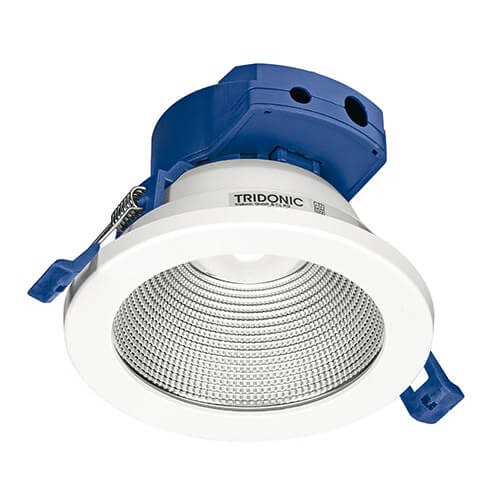
For a recessed downlight replacement, record the existing ceiling cutout, available depth and required beam spread before comparing products. INOVEC’s Tridonic DLA G2 downlight system is one catalog option to review: the listed system combines the module, driver, reflector and trim ring, with different sizes and configurations. Confirm the exact variant and current availability for your project.
A downlight is not the answer to every space. Browse the LED lighting range to compare panels, downlights, strips and modules against the application. Ask for the relevant datasheet and a lighting assessment before treating two fittings as equivalent.
Reduce unnecessary operating hours
Replacing fittings addresses power consumption; controls address when and how much light is needed. Occupancy control can suit intermittently used rooms, while daylight response can reduce electric-light output near windows. Schedules help where operating hours are predictable. These approaches are described in the Australian Government’s business lighting guide.
Review INOVEC’s lighting controls and connectivity range with the proposed fitting and driver details. For a suitable DALI-2 system, the ENOV EV-DA9030A-PIR ceiling sensor combines motion and light sensing. Do not assume a fitting is dimmable or compatible with the existing control system simply because it uses LEDs. Agree the control method and test the intended operation before ordering the full quantity.
Treat lifetime as a specification, not a promise
LED light output can decline over time, and a driver or other component can fail before the LED source reaches its stated life. The Department of Energy’s guide distinguishes lumen maintenance from complete-product reliability. Ask what the stated lifetime measures, under which conditions, and what the warranty actually covers.
For your project, include operating conditions, maintenance access and replacement arrangements in the enquiry. A sustainable upgrade needs a practical service plan as well as a lower input wattage.
Planning an LED lighting upgrade in Qatar?
Send INOVEC the existing fitting model or a clear photograph, quantity, operating hours, ceiling dimensions and desired control method. Include the lighting schedule or project specification if available. These details make it easier to compare suitable options and prepare a useful quotation.
Contact INOVEC about your LED lighting requirements, or start with the LED product catalog.