LED Lighting: Energy Savings and Selection Guide

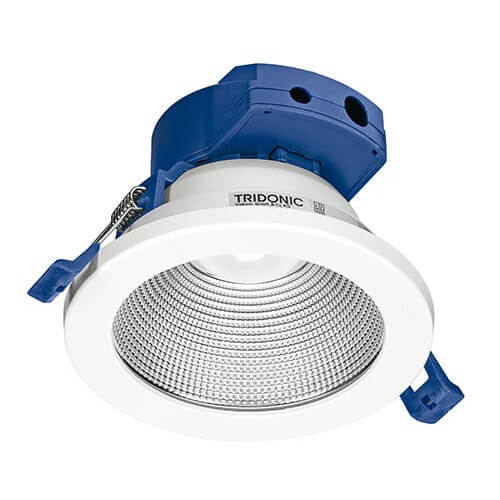
DLA-G2-100mm-1000lm

A lighting upgrade should lower electricity use without leaving a room dim, uncomfortable or difficult to maintain. LED lighting can help, but the result depends on the fitting, its driver, the controls and how long the lights operate. For a Qatar office, shop or residential project, start with the light the space needs, then compare the power needed to deliver it.

Compare useful light, not just watts

Watts describe electrical power; lumens describe light output. Compare complete fittings at the required output rather than buying the lowest-wattage option. The light distribution matters too: a fitting that sends light where it is needed can be more useful than one with a higher headline lumen figure.

Check colour temperature, colour rendering and glare alongside efficiency. The U.S. Department of Energy’s LED basics guide explains why the LED source, power supply and fitting design all affect system performance. An efficient LED chip alone does not guarantee an efficient finished luminaire.

How much energy could an LED upgrade save?

Use the total input power of the old and proposed fittings, including their control gear, and the actual operating hours. The following is an illustrative calculation, not a product claim or a forecast for a particular building.

  • Existing installation: 100 fittings at 60 W total input each.
  • Proposed installation: 100 LED fittings at 30 W each, subject to a lighting design confirming suitable illumination.
  • Operating schedule: 10 hours a day for 300 days a year.

Annual electricity reduction = 100 × (60 − 30) ÷ 1,000 × 3,000 = 9,000 kWh.

In this example, lighting electricity use falls from 18,000 to 9,000 kWh a year. Multiply the reduction by your applicable electricity rate to estimate the energy-cost saving. Then compare that with the installed upgrade cost. Keep any maintenance or cooling benefit separate so it is not counted twice. A building that already has efficient lighting or short operating hours will need a different business case.

Choose the fitting for the application

For a recessed downlight replacement, record the existing ceiling cutout, available depth and required beam spread before comparing products. INOVEC’s Tridonic DLA G2 downlight system is one catalog option to review: the listed system combines the module, driver, reflector and trim ring, with different sizes and configurations. Confirm the exact variant and current availability for your project.

A downlight is not the answer to every space. Browse the LED lighting range to compare panels, downlights, strips and modules against the application. Ask for the relevant datasheet and a lighting assessment before treating two fittings as equivalent.

Reduce unnecessary operating hours

Replacing fittings addresses power consumption; controls address when and how much light is needed. Occupancy control can suit intermittently used rooms, while daylight response can reduce electric-light output near windows. Schedules help where operating hours are predictable. These approaches are described in the Australian Government’s business lighting guide.

Review INOVEC’s lighting controls and connectivity range with the proposed fitting and driver details. For a suitable DALI-2 system, the ENOV EV-DA9030A-PIR ceiling sensor combines motion and light sensing. Do not assume a fitting is dimmable or compatible with the existing control system simply because it uses LEDs. Agree the control method and test the intended operation before ordering the full quantity.

Treat lifetime as a specification, not a promise

LED light output can decline over time, and a driver or other component can fail before the LED source reaches its stated life. The Department of Energy’s guide distinguishes lumen maintenance from complete-product reliability. Ask what the stated lifetime measures, under which conditions, and what the warranty actually covers.

For your project, include operating conditions, maintenance access and replacement arrangements in the enquiry. A sustainable upgrade needs a practical service plan as well as a lower input wattage.

Planning an LED lighting upgrade in Qatar?

Send INOVEC the existing fitting model or a clear photograph, quantity, operating hours, ceiling dimensions and desired control method. Include the lighting schedule or project specification if available. These details make it easier to compare suitable options and prepare a useful quotation.

Contact INOVEC about your LED lighting requirements, or start with the LED product catalog.
IoT in HVAC Systems

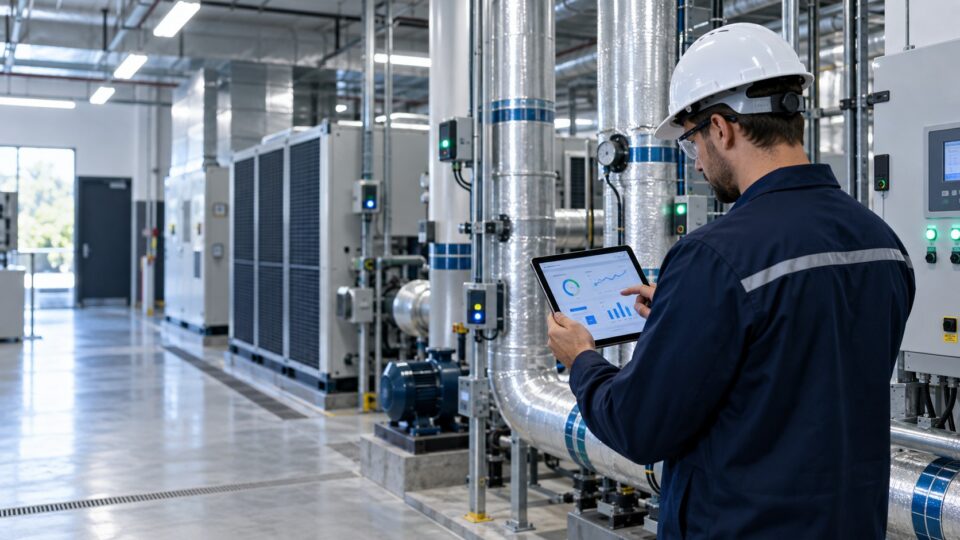
Facilities engineer monitoring a connected HVAC plant through a building management system

IoT in HVAC is not simply a mobile app for changing a thermostat. In a commercial building, it is the connected layer that brings together field sensors, controllers, meters, drives and software so that operations teams can see conditions, respond to alarms and improve control over time.

For facilities in Qatar, where cooling systems often run for long hours, clear visibility of temperatures, schedules, valve positions, fan status and energy use can help teams identify avoidable operation. The value comes from applying the data to a defined operating strategy—not from connectivity alone.

What Does IoT Mean in HVAC?

The Internet of Things (IoT) describes physical devices that collect, exchange or act on data through a network. In HVAC, that may include room thermostats, temperature and humidity sensors, CO₂ sensors, energy meters, variable-frequency drives (VFDs), actuators and controllers. A building management system (BMS) or cloud-connected platform can present that information through dashboards, trends, alarms and control sequences.

IoT-enabled equipment can complement a conventional BMS. The goal is not necessarily to move every control point to the cloud; it is to make the right information available to the right people while maintaining reliable local control, cybersecurity and clear operator responsibility.

How Connected HVAC Systems Work

  • Sense: field devices measure variables such as temperature, humidity, pressure, flow, occupancy or equipment status.
  • Control: local controllers apply approved sequences—for example, modulating a valve, staging equipment or resetting a fan speed.
  • Communicate: selected points are shared through the building network using an appropriate, documented integration approach.
  • Visualise and act: operators review trends, alarms and energy data, then investigate faults or adjust authorised schedules and setpoints.

This structure supports better decisions without removing the need for correct mechanical design. Sensor location, calibrated instruments, safe operating limits and clear sequences of operation remain fundamental.

Practical IoT and BMS Use Cases

1. Remote condition monitoring

Dashboards can bring AHU, FCU, pump and plant information into one view. Operators can compare supply-air temperature, valve command, fan proof and room conditions before attending site, helping them prioritise the right issue.

2. Alarm management and fault investigation

Meaningful alarms are more useful than a long list of notifications. A well-configured system should identify abnormal conditions, record their timing and help an operator distinguish a genuine equipment problem from a temporary operating state. Alarm priorities and escalation paths should be agreed during commissioning.

3. Schedule and setpoint discipline

Many savings opportunities begin with basic control discipline: matching run times to occupancy, avoiding simultaneous heating and cooling, and reviewing setpoints against actual requirements. Connected trends make those conversations evidence-based.

4. Demand-responsive ventilation and comfort

Where the HVAC design and applicable requirements allow it, occupancy or air-quality signals can help a system adjust ventilation and airflow to changing use. The strategy must be engineered carefully so indoor-air-quality and minimum ventilation requirements are maintained.

A Practical Implementation Checklist

  • Start with a measurable objective: reduce comfort complaints, improve plant visibility, verify schedules or monitor energy.
  • Develop a point list and confirm each sensor, actuator, meter and communication interface.
  • Document the sequence of operation, setpoint ownership and alarm priorities before programming.
  • Use interoperable, supportable equipment and involve IT stakeholders early where networks are shared.
  • Commission the system under realistic operating conditions and train the facilities team to use the trends and alarms.
  • Review performance regularly; a dashboard only creates value when someone acts on the information.

Choosing the Right Starting Point

For an existing building, a phased approach is often more practical than a complete replacement. Begin with the critical equipment or the problem that is easiest to define, then scale after the team has verified the operating benefit. For a new project, build the controls specification around the building’s operating requirements from the start.

Planning a connected HVAC or BMS project in Qatar? INOVEC Trading can help you review suitable BMS and automation solutions, including controllers, sensors, thermostats, valves, actuators and drive integration for your application.

Frequently Asked Questions

Is IoT the same as a BMS?

No. A BMS is a building-control system that supervises and regulates building equipment. IoT devices and connected software can extend the data, integration or remote-monitoring capabilities around that system.

Can IoT reduce HVAC energy use?

It can help identify control and scheduling opportunities, but savings depend on the HVAC design, control strategy, commissioning and ongoing operation. Connectivity by itself does not guarantee a reduction.

Which HVAC points should be monitored first?

Begin with the points that support the operating objective—typically critical temperatures, equipment status, alarms, energy data, valve or damper position and VFD feedback.

What should be considered before connecting HVAC systems to a network?

Confirm the control architecture, cybersecurity responsibilities, network access, support model and safe local operation. Use documented protocols and involve the project’s controls and IT teams early.

Variable-Speed HVAC Systems

HVAC systems rarely need to operate at full capacity all day. Cooling demand changes with outdoor temperature, occupancy, equipment loads and the time of day. A variable-speed HVAC system responds to those changes by adjusting its output instead of repeatedly running at full power and switching off.

For buildings in Qatar, where air-conditioning can account for a significant share of electricity use, matching HVAC output to actual demand can improve comfort and help reduce wasted energy. The result depends on correct equipment selection, control design and commissioning, but the operating principle is simple: deliver only the airflow, water flow or cooling capacity the building needs.

How Do Variable-Speed HVAC Systems Work?

“Variable speed” can describe several technologies. In packaged and residential air-conditioning equipment, an inverter-driven compressor can increase or decrease cooling capacity. In commercial buildings, a variable frequency drive (VFD), also called a variable speed drive (VSD), controls the speed of motors serving fans, pumps and other HVAC equipment.

Sensors and controllers monitor conditions such as temperature, pressure, airflow or water flow. The building management system or local controller then sends a demand signal to the drive. When demand falls, the motor slows down; when demand rises, it speeds up within the system’s approved operating limits.

Key Benefits of Variable-Speed HVAC Systems

1. Lower Energy Consumption

Fixed-speed motors are often sized for peak conditions even though most operating hours occur at partial load. A VFD allows a fan or pump to reduce speed when full output is unnecessary. Because centrifugal fan and pump power falls quickly as speed is reduced, properly designed variable-flow systems can use substantially less electricity than constant-speed operation.

2. More Stable Temperature and Comfort

Instead of alternating between maximum output and no output, variable-speed equipment can make smaller adjustments over longer operating periods. This helps reduce noticeable temperature swings and supports more consistent airflow across occupied spaces.

3. Quieter Operation

Fans and compressors generally produce less noise when they operate below maximum speed. Gradual acceleration and deceleration can also reduce the sudden sound associated with conventional equipment starting and stopping.

4. Reduced Mechanical Stress

Soft starting limits the electrical and mechanical shock created by across-the-line motor starts. Fewer hard starts can reduce stress on belts, bearings and other connected components. This does not replace preventive maintenance, but it can support more reliable operation when the drive is selected and commissioned correctly.

5. Better Control and BMS Integration

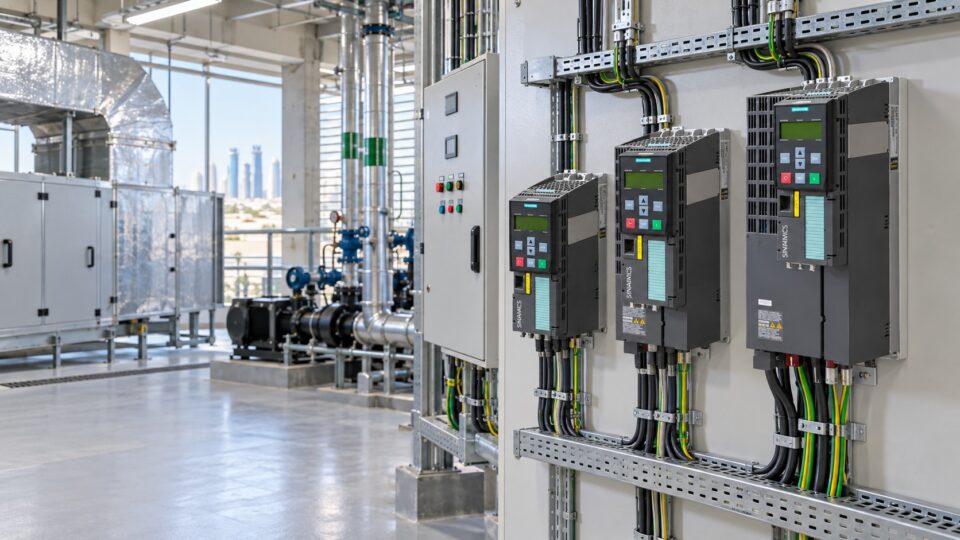
Modern HVAC drives can work with sensors, controllers and building management systems to maintain pressure, temperature or flow setpoints. Depending on the selected equipment, operators may also gain access to alarms, operating data and diagnostic information that simplify monitoring and troubleshooting.

Common VFD Applications in HVAC

  • Supply and return fans in air handling units
  • Chilled-water and condenser-water pumps
  • Cooling-tower fans
  • Variable air volume systems
  • Exhaust and ventilation fans

Selection and Commissioning Matter

A variable-speed drive must match the motor, electrical supply, environmental conditions and control strategy. Engineers should also consider harmonics, electromagnetic compatibility, enclosure protection, minimum safe speeds and bypass requirements. Poor selection or incorrect programming can reduce performance and reliability, so application review and professional commissioning are essential.

Is Variable-Speed HVAC Worth Considering?

Variable-speed HVAC systems are especially valuable where fans, pumps or compressors operate for long hours under changing loads. They can reduce unnecessary energy use, improve control and create a quieter, more consistent indoor environment. The best results come from evaluating the complete system rather than treating the drive as a stand-alone component.

Looking for a VFD or soft starter for an HVAC application in Qatar? INOVEC Trading can support product selection for your project requirements. Explore our VFD and soft starter solutions or contact our team for technical assistance.